
Build Up / Phoenix: Open-source social media analysis for peacebuilding and democracy
Phoenix is an open-source social media analysis platform built by Build Up, an organisation working at the intersection of peacebuilding and technology.
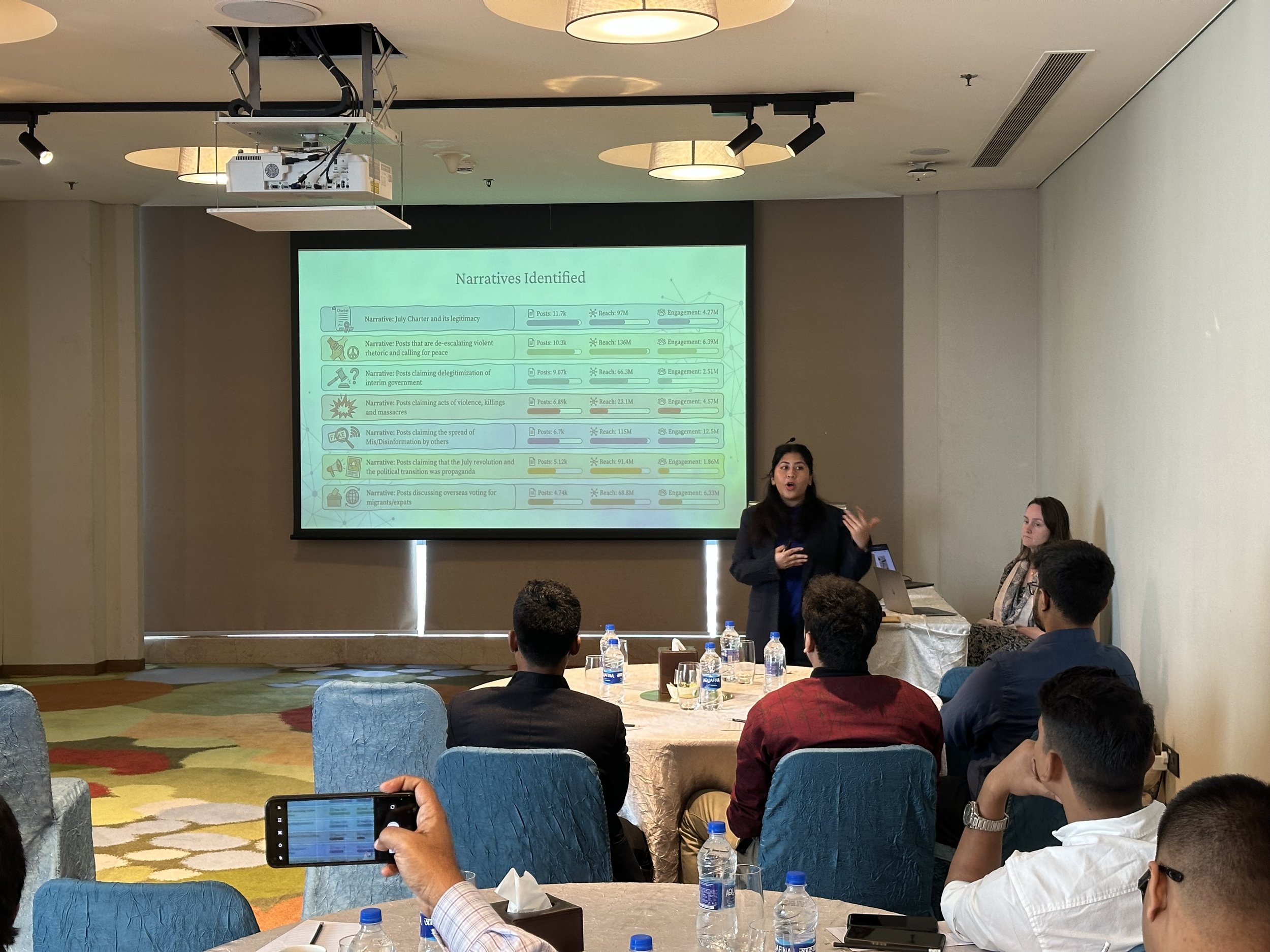
In Bangladesh, a Phoenix training ahead of elections in February 2026. (Photo: Build Up)
Developed to help civil society, media, and peacebuilding organisations understand what is being said online in the specific contexts they work in, Phoenix lets users collect, classify, and visualise social media data — without coding experience, big-tech lock-in, and without cost.
The problem to solve
When conflict emerges, social media becomes a critical part of the landscape — and understanding it matters enormously. But the tools available to do this have long been either unaffordable or inadequate. Commercial social listening platforms like Meltwater, Brandwatch, and Brand 24 are priced out of reach for most civil society and media organisations. When they can access them, users find these tools lack the ability to archive data for future reference, perform meaningful custom classifications, or adapt to local languages and cultural contexts.
When Meta shut down CrowdTangle — a key free tool for researchers — the gap became acute. Organisations doing election monitoring, conflict analysis, fact-checking, and disinformation research were left without a viable route to the data they needed. Phoenix was built to fill that gap: a free, open-source alternative designed around public interest use, not commercial extraction.
What they did
Built an open-source platform initially seeded by Swiss government funding, now maintained through overhead from Build Up's own project work — covering election monitoring, conflict analysis, and peacebuilding commissions — so the tool remains free to all users working in the public interest.
Designed for three core functions in one place: data collection, classification, and visualisation, removing the need to stitch together multiple tools.
Enabled collection from Facebook, TikTok, Instagram, and X, with YouTube, and Telegram integrations in development, and a manual upload function for data gathered through other means.
Built custom classification tools that allow users to categorise data by author type (politician, journalist, influencer), by keyword or lexicon (including hate speech and narrative terms defined in local context), and through open-source AI models from Hugging Face applied directly to collected data to enable more advanced analysis.
Trained a context-specific model for Kenya — working with local annotators to label over 10,000 posts in four months — to detect polarisation in Kiswahili and other Kenyan languages, where no existing model existed.
Used deliberative technologies alongside Phoenix, linking social media analysis to offline and online citizen consultations — including a WhatsApp chatbot and deliberative tools such as pol.is and Remesh — to turn research findings into policy briefs, media stories, and stakeholder engagement.
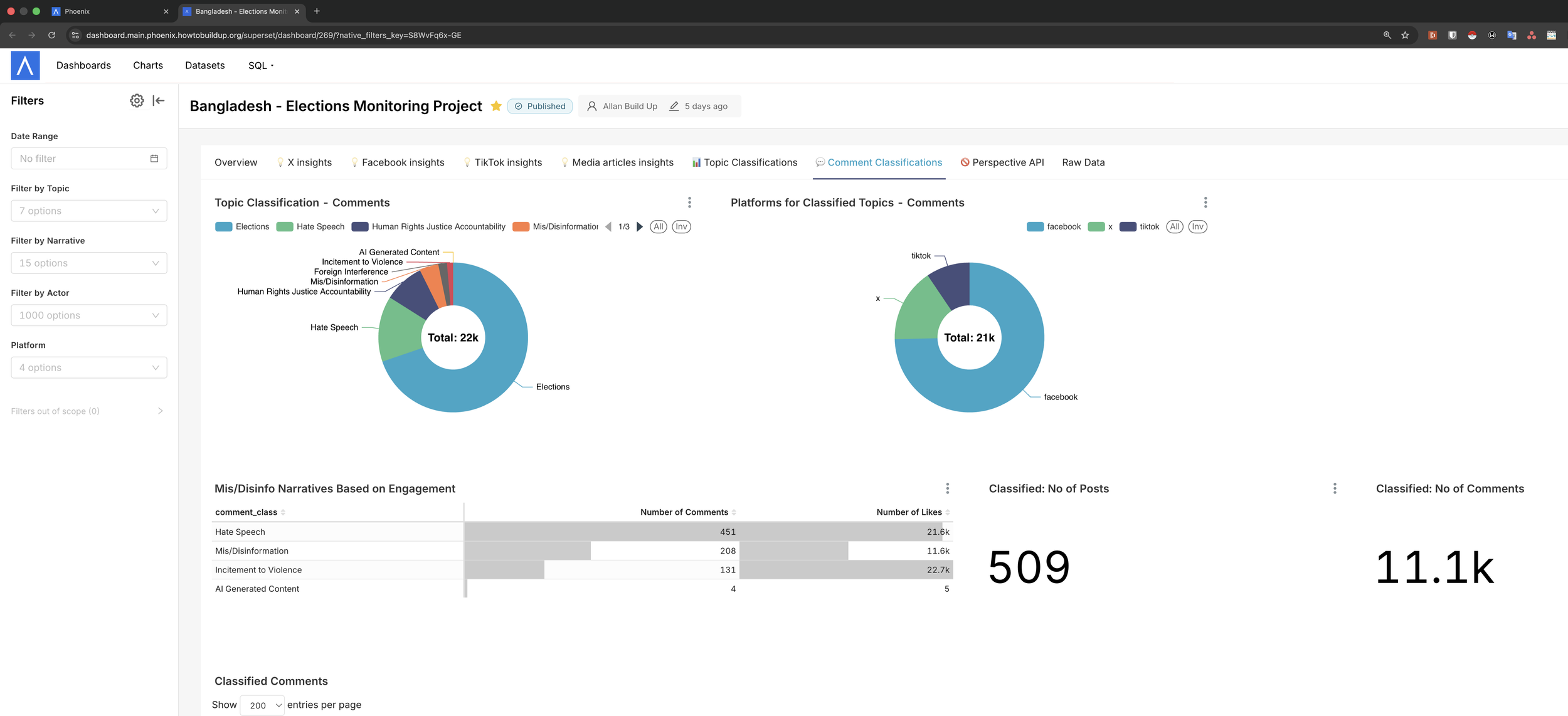
A screenshot of the Phoenix dashboard displaying narratives shared on social media platforms ahead of Bangladesh’s 2026 general election
Key success factors
Designed for non-technologists. The platform is built around the people who design the analysis — journalists, researchers, peacebuilders — not just data engineers. No coding experience is required for collection and classification; only the visualisation step may benefit from some data literacy.
Context-first classification. Unlike tools that surface narratives algorithmically, Phoenix requires users to bring their own local knowledge: the keywords, topics, and categories that are meaningful in their specific context. This keeps analysis rooted in the community rather than in platform logic.
Mentorship-based collaboration. Build Up actively phases out extractive consulting (where they do the analysis and hand over a report) in favour of mentorship models — three-day workshops, weekly online check-ins, and joint project cycles — that build lasting local capacity.
Privacy-by-design. Phoenix uses only publicly available and open-source data, complies with GDPR, and does not attempt to geolocate users beyond what they have self-disclosed. Location data limitations are treated as ethical commitments, not technical failings.
A credit system that encourages intentional use. Rather than unlimited access, organisations receive a credit allowance (roughly 1,000 posts per credit) that encourages thoughtful, focused queries but can be extended on request.
The ask
“We want to connect to partners implementing different projects that would be complementary. Then we can either fundraise together or figure out how we'll be able to implement together."
— Allan Cheboi, Data and Digital Technology Lead, Build Up
Recommendations for strong digital communities
Archive before analysis
Deleted posts still matter as evidence; store data before platforms remove it.
Bring local knowledge
No algorithm can substitute for community understanding of what terms, narratives, and actors are meaningful in a specific context.
Build capacity, not dependency
Mentorship and collaborative projects create lasting local infrastructure; outsourced analysis does not.
Train your own models
Where no open-source classifier exists for a language or context, it is possible to build one with a relatively small but well-annotated dataset.
Connect research to action
Social media analysis is most powerful when it feeds directly into stakeholder briefings, deliberation, policy advocacy, or public reporting.
Respect privacy
Ethical compliance with privacy norms is not an obstacle to analysis; it is a condition of trustworthy research.
Build Up and Phoenix demonstrate that social media analysis for the public interest does not require a large budget, a technical team, or dependence on commercial platforms. By combining an open-source tool with mentorship, local knowledge, and a commitment to capacity-building over extraction, Build Up has created infrastructure that is replicable, adaptable, and genuinely community-centred. In contexts where understanding online conversation can be a matter of safety, electoral integrity, or democratic accountability, Phoenix offers a practical and principled alternative.
Work with Build Up
Build Up welcomes introductions to civil society organisations, media outlets, and researchers working on disinformation, hate speech, conflict, or election monitoring who might benefit from Phoenix or partner on joint analysis projects. Organisations working in the public interest who bring their own ground-level knowledge of the communities and issues they are monitoring can apply for a free account directly through the Build Up website. Apply to use Phoenix.